
DeWitt County Court Records After a Jail Arrest
After a DeWitt County arrest, the booking record and the court case are not the same record. The DeWitt County Sheriff's jail page says corrections staff can confirm only whether a person is incarcerated and the amount of bond. It also says charges, court dates, and medical information will not be released by corrections staff by phone. That local rule is the practical dividing line: use the jail for custody and bond confirmation, then move to court channels for charges and hearings.
The case path runs through DeWitt County's 6th Judicial Circuit court system. State's Attorney Dan Markwell is the charging prosecutor, and the Circuit Clerk, Michelle Van Valey, maintains the local court record once a case is filed. The public case-search route is Judici's direct DeWitt County search. For the custody side of the same event, use jail inmate records. For booking-photo questions, use jail mugshots.
From Arrest and Booking to Court Records
The first step is the arrest and intake at the DeWitt County Jail. Jail staff record custody status and bond information, but the court record does not fully exist until a filing is processed. A police report, jail booking entry, or probable-cause information may describe allegations. The formal case record is different because it reflects what the State's Attorney files and what the court later orders.
- Arrest and booking: the person is taken into local custody and processed at the jail.
- First appearance and pretrial review: the court addresses release conditions, detention issues, and early hearing dates under Illinois pretrial law.
- Prosecutor charging decision: the State's Attorney may file, amend, reduce, dismiss, or decline charges.
- Circuit Clerk record: the filed case becomes part of the DeWitt County court record and may appear through Judici when public and processed.
- Later case events: hearing dates, dispositions, fines, sentences, and transfer orders belong in the court record rather than the jail phone inquiry.
This timing matters for people searching right after an arrest. A person may be in the jail before the public case index shows every count. Conversely, a court case may remain visible after the person has been released, sentenced, transferred to IDOC, or otherwise moved out of county custody.
Judici Case Search for DeWitt Court Records After Arrest
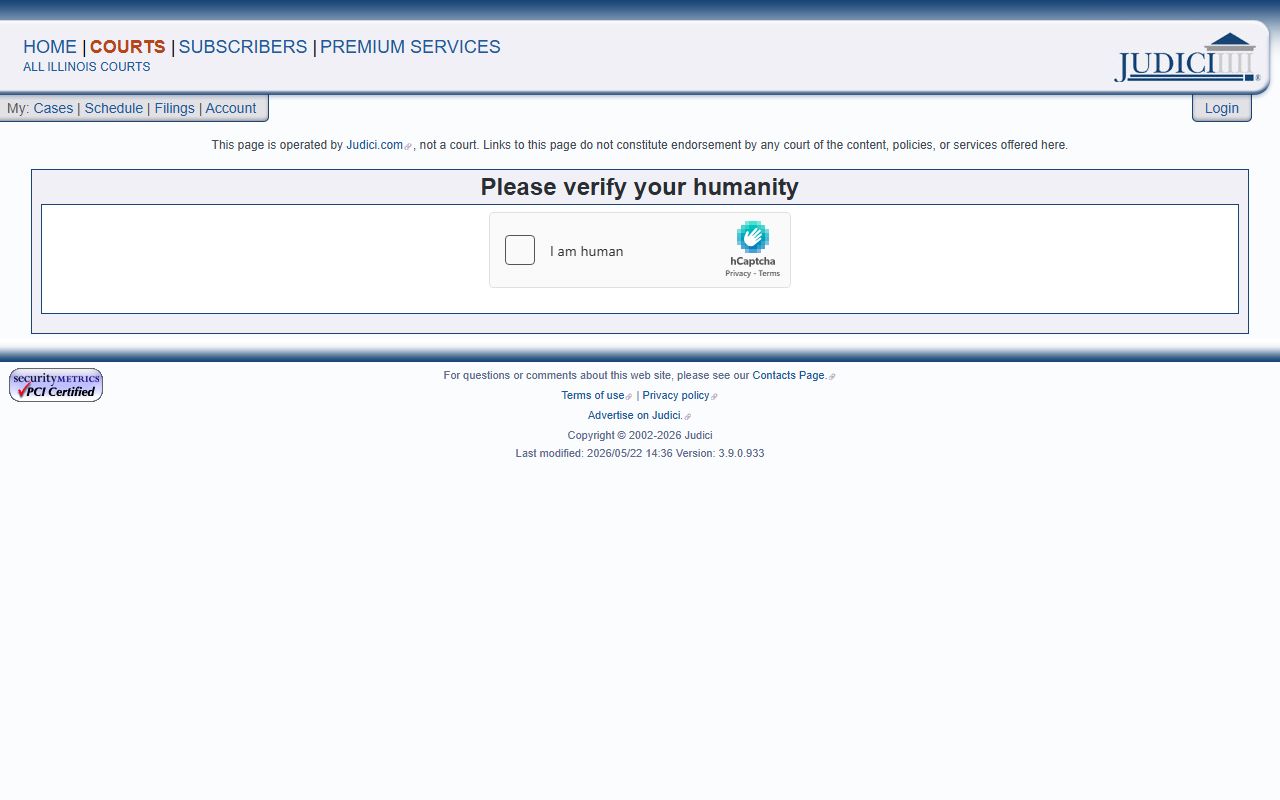
Judici is the public case-search portal linked by local and court sources for DeWitt County. The direct DeWitt County case-search route is Judici's DeWitt County court page. Static inspection reached a hCaptcha screen, so automated capture did not verify every live field. Judici's public materials and visible navigation indicate that public access may include litigant information, criminal charges, dispositions, sentences, civil judgments, fines and fees, payment details, hearing dates, case minutes, will indexes, and documents depending on court access and account status.
The screenshot below comes from the direct DeWitt County Judici case-search page.
Use Judici as a court-case tool, not as a jail roster or active-warrant database.
| Search Field or Element | Type | Required | Local Notes |
|---|---|---|---|
| hCaptcha verification | Challenge | May appear | The direct DeWitt URL required human verification during static inspection. |
| Case number | Search field | When known | Useful when a ticket, complaint, or clerk notice already lists a case number. |
| Name | Search field | Common search method | Use the defendant's legal name and try spelling variants if needed. |
| Court/county | Portal parameter | Yes | The DeWitt direct URL uses court=IL020015J. |
| Login/subscriber links | Account feature | No for basic public access | Visible navigation includes Login, Subscribers, Premium Services, My Cases, Schedule, Filings, and Account. |
Circuit Clerk Contact for DeWitt Court Records
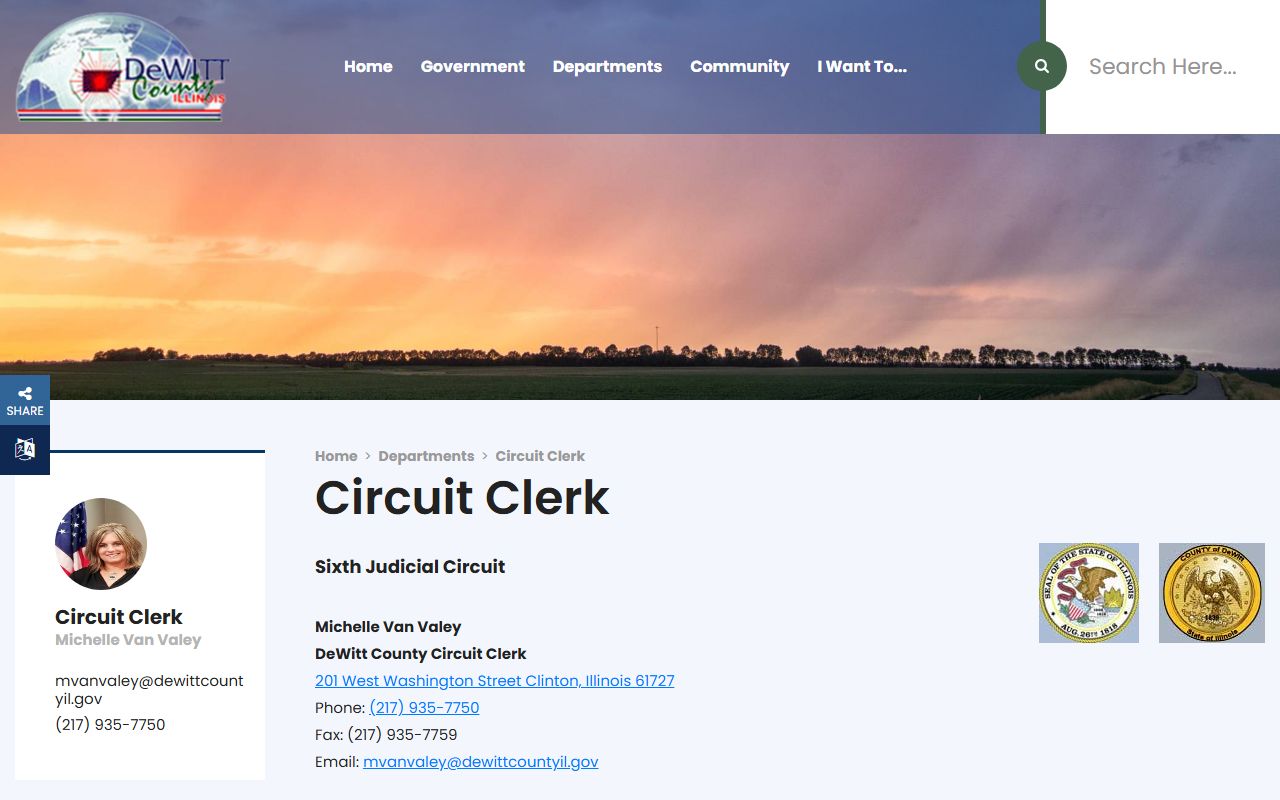
Michelle Van Valey is the DeWitt County Circuit Clerk. The clerk page lists the office at 201 West Washington Street, Clinton, IL 61727, phone 217-935-7750, fax 217-935-7759, and email mvanvaley@dewittcountyil.gov. Office hours are Monday through Friday, 8:30 a.m. to 4:30 p.m., with a lunch closure from noon to 1:00 p.m. The Illinois Courts directory lists DeWitt County Courthouse in the 6th Judicial Circuit and the 5th District, with the same courthouse address and court phone and fax.
The screenshot below comes from the official DeWitt County Circuit Clerk page.
The clerk is the local office to contact when a Judici search is unclear, a certified copy is needed, or the case record has not appeared online.
Charging Documents After a DeWitt County Arrest
The State's Attorney is the office that files and pursues criminal charges after arrest. DeWitt County's State's Attorney is Dan Markwell. County and Sixth Judicial Circuit sources list the office at the DeWitt County Courthouse, 201 West Washington Street, Clinton, IL 61727, phone 217-935-7810, fax 217-935-7819, and dmarkwell@dewittcountyil.gov. A charging document is the point where an allegation becomes a formal court count.
| Document | Filed By | Common Use | What to Check |
|---|---|---|---|
| Complaint | Law enforcement or prosecutor | Often used near the start of a criminal case | Offense name, statute citation, date, count number, and filing date. |
| Information | State's Attorney | Prosecutor-filed charging document in many criminal cases | Whether it replaces, amends, or clarifies earlier allegations. |
| Indictment | Grand jury process | Serious felony matters where grand jury charging is used | Counts returned, offense class, and later amendments or dismissals. |
| Petition to deny pretrial release | State's Attorney | Cases where the State seeks pretrial detention under Illinois law | Whether the court held the required hearing and made detention findings. |
Charge Status in Court Records After Arrest
Booking allegations can differ from filed charges. The prosecutor may file different counts, add charges, reduce a felony to a lesser offense, dismiss a count, or decide not to pursue a charge. Read each count separately because one charge may be dismissed while another remains pending or ends in a conviction.
| Status | Plain-English Meaning | Record Caution |
|---|---|---|
| Pending | The charge has not reached a final disposition. | Do not treat a pending charge as a conviction. |
| Amended | The filed charge was changed after the original filing. | Compare earlier and later counts before summarizing the case. |
| Reduced | The charge was lowered to a lesser offense or class. | The final disposition may not match the arrest allegation. |
| Dismissed | The count ended without a conviction on that charge. | Other counts in the same case may still continue. |
| Nolle prosequi | The prosecutor declined to pursue that count. | It is a prosecutor action, not a guilty finding. |
| Convicted | A judgment of guilt was entered by plea or verdict. | Check sentence, fines, probation, jail credit, or IDOC transfer details separately. |
First Appearance, Pretrial Release, and Detention
Illinois no longer uses ordinary cash bail as the central pretrial release system. The Pretrial Fairness Act took effect on September 18, 2023, after the Illinois Supreme Court upheld the relevant provisions on July 18, 2023. Current Illinois court records should be read in terms of pretrial release, release conditions, and pretrial detention, even though local jail language may still mention a bond amount for custody confirmation.
Under 725 ILCS 5/110-2, people charged with an offense are generally eligible for pretrial release before conviction and are presumed entitled to release on personal recognizance with required court attendance, no new criminal offense, and compliance with conditions. Under 725 ILCS 5/110-6.1, detention requires a verified State petition, a hearing, statutory timing, clear-and-convincing evidence, and individualized court findings. Release conditions under 725 ILCS 5/110-5 must be tied to appearance, safety, and compliance.
| Record Item | What It Means Now | Where It Appears |
|---|---|---|
| Custody or bond confirmation | The jail may confirm custody status and bond amount by phone. | DeWitt County Jail phone channel. |
| Pretrial release order | The court allowed release subject to required appearances and conditions. | Circuit Clerk or Judici case record when public. |
| Release conditions | Conditions may address appearance, safety, contact, movement, or supervision. | Court order and case minutes. |
| Pretrial detention | The court ordered detention after the statutory petition and hearing process. | Court order and hearing record. |
Warrants, Arrest, and Court Records
Do not use Judici as an active-warrant search for DeWitt County. The sheriff FAQ says active arrest warrants are not listed on Judici because of Illinois AOIC regulations. It also says that once a warrant is served, information is posted on Judici. That makes Judici useful after service and case processing, not before an arrest warrant is served.
The sheriff FAQ says people with information about someone with an active warrant should contact local law enforcement and lists DeWitt CrimeStoppers at 217-935-3333. For specific warrant information, the FAQ says the sheriff will release specific warrant information in person to the defendant. A written FOIA request may be available for some records, but law-enforcement exemptions can apply to active warrants and pending investigations.
Charges vs. Convictions in Court Records
An arrest and a charge are not the same as a conviction. A charge is an accusation filed or pursued in court. A conviction is a judgment of guilt by plea or verdict. This distinction is especially important when reading court records after a jail arrest because early records may list allegations that later change or disappear.
| Question | Charge | Conviction |
|---|---|---|
| Stage | Filed accusation after arrest or prosecutor review. | Final guilt finding by plea or verdict. |
| Proof level | Not proof of guilt. | Requires a valid plea or finding beyond a reasonable doubt. |
| Can it change? | Yes, it may be amended, reduced, dismissed, or not pursued. | The judgment may still be appealed, vacated, sealed, or expunged if eligible. |
| How to describe it | Use "charged with" or "pending charge" when unresolved. | Use "convicted of" only when the court record supports it. |
Sealed vs. Expunged Arrest and Court Records
Illinois law at 20 ILCS 2630/5.2 governs expungement and sealing. Petitions generally go through the clerk in the county where the arrest occurred or charges were brought. A sealed record is hidden from most public access. An expunged record is treated more strongly under the statute, depending on eligibility and the order entered. Neither result should be assumed from a dismissal alone unless a court order has been entered.
| Issue | Sealed | Expunged |
|---|---|---|
| Public visibility | Hidden from most public case searches and ordinary public inspection. | Removed or treated as not publicly existing under the expungement order. |
| Agency access | Some agencies may retain limited lawful access. | Access is more limited and controlled by the order and statute. |
| Eligibility | Depends on offense, disposition, waiting periods, and statutory exclusions. | Often tied to arrests, dismissals, acquittals, or other eligible outcomes. |
| Practical step | Use Illinois Courts standardized sealing forms and file in the proper court. | Use Illinois Courts standardized expungement forms and file in the proper court. |
FOIA for Arrest Records That Support the Court Case
Court records are not the only records connected to an arrest. Arrest reports, booking records, and some booking-photo requests follow the Illinois Freedom of Information Act route. DeWitt County's FOIA page routes written FOIA requests to the DeWitt County State's Attorney, P.O. Box 439, Clinton, IL 61727. The request should include the requester's name, address, phone number, email, the records requested, how the requester wants to inspect records, and whether the request is for commercial purposes.
Illinois FOIA generally requires a public body to respond to or deny a request within five business days unless a lawful extension applies. 5 ILCS 140/2.15 covers arrest-report information and photographs when available, subject to exceptions for law enforcement, safety, confidential sources or techniques, and correctional facility security. FOIA is a records process, not a way to make jail staff give court dates by phone.
FCRA notice: DeWitt County Inmate Population is not a consumer reporting agency, and information here may not be used for credit, employment, tenant, insurance, or other FCRA-covered decisions.